
The Value of Practical Knowledge
A Journey to the Centre of the EarthThis thread shows how local skill and hands-on judgment repeatedly correct the assumptions of more formal scientific authority.
increasing Bearing strength in each event
 decreasing
Bearing strength in each eventdecreasingThe Guide’s Knowledge
The Guide’s Knowledge
Expertise outside the study
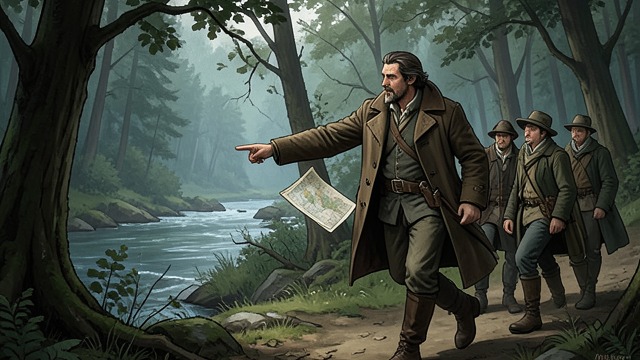
Hans Bjelke understands the terrain through experience, not through the instruments and maps that Professor Hardwigg values. He knows which routes horses can take and when water conditions make a crossing safe.
The Professor’s impatience cannot make the landscape conform to his schedule. Hans’s quiet decisions supply knowledge that the expedition’s scholarly authority does not possess.
A necessary correction
At the fjord, Hans indicates that the party must wait for the tide rather than force a crossing. The delay frustrates the Professor but prevents an unnecessary danger.
The episode establishes practical knowledge as a form of expertise, not an inferior substitute for formal learning.
Reading the Mountain
Reading the Mountain
Terrain as instruction
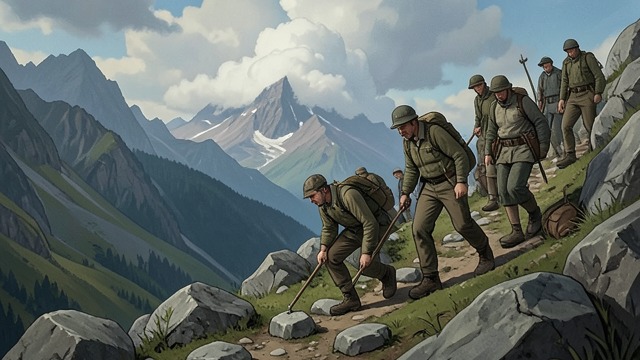
Hans marks the route with small piles of stones and guides the party through difficult slopes. When a moving mass of pumice threatens the climbers, he recognizes the danger and leads them away.
His decisions come from careful attention to local conditions, not from confidence that a map or theory can settle every immediate question.
Judgment in action
Professor Hardwigg possesses the expedition’s scientific ambition, but Hans’s practical response keeps the group alive on the mountain. The travelers succeed through a combination of study and embodied experience.
The mountain makes the value of local knowledge visible before the group enters the more complex underground world.
Hearing the Hidden River
Hearing the Hidden River
Attention before instruments
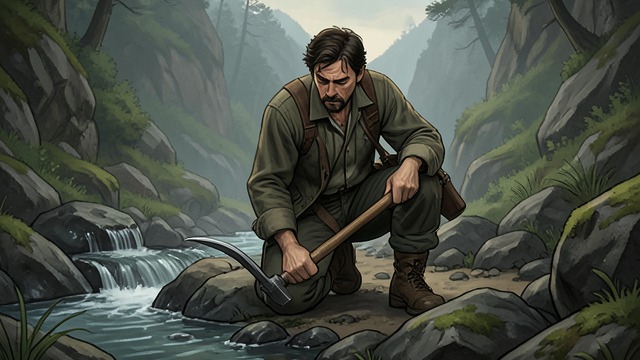
Hans listens for water running behind solid granite, then identifies where its sound comes closest to the passage. His method depends on patience and a trained sensitivity to the surrounding rock.
The crowbar’s careful use opens a spring that the travelers had not found through their earlier calculations. The resource is discovered by listening, testing, and working in measured strokes.
Expertise shared
Henry and Professor Hardwigg acknowledge that Hans’s simple method has saved them. The episode does not reject science; it shows that scientific travel depends on skills that may not be captured by instruments.
Hans’s knowledge becomes part of the expedition’s survival and its continuing route.
Restraint at Sea
Restraint at Sea
Action withheld
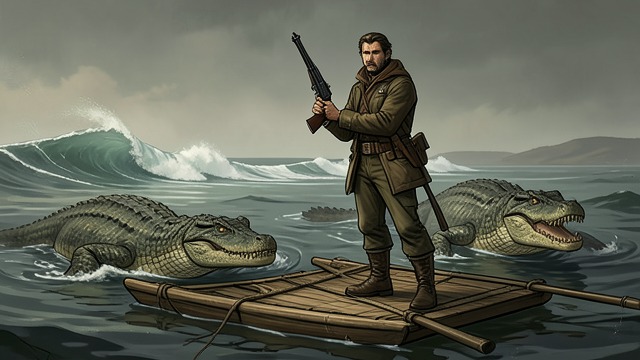
Henry prepares to fire during the combat between the Ichthyosaurus and Plesiosaurus. Hans signals him to wait, recognizing that a shot is unlikely to help and might direct the creatures’ attention toward the raft.
The Professor’s instruments and zoological expertise identify what the travelers are seeing, but Hans’s restraint guides what they should do about it. Observation and action require different kinds of judgment.
Survival through timing
The reptiles turn on each other, giving the travelers time to escape the immediate danger. Hans’s decision not to interfere proves wiser than Henry’s impulse to use the weapon.
The episode presents caution not as cowardice but as a practical response to overwhelming forces.
The Work of Rescue
The Work of Rescue
Labor beyond recognition
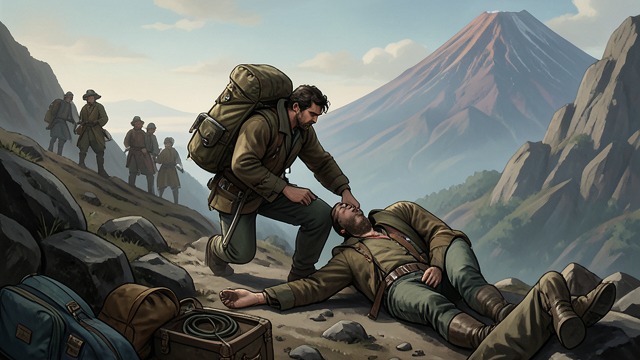
Hans saves instruments and provisions from the wreck while the others rest, then repeatedly supports the party through injury and danger. His contribution is continuous and practical, not a single display designed to earn fame.
During the rising volcanic passage, his strength helps keep Henry alive. The party’s escape depends on actions carried out without certainty that they will be rewarded.
A different measure of achievement
After returning to the surface, Hans leaves Hamburg for Iceland rather than accepting public attention or payment beyond what he is owed. His priorities remain home, work, and the terms he agreed to.
The expedition’s most reliable guide measures success less by scientific reputation than by fulfilling his responsibilities and returning to his own life.
Early in the overland journey, at the Hvalfjord crossing
June 27, as the climbing party encounters the mistour
After the torrent is heard behind the rock
During the battle on the Central Sea
From the wreck recovery through Hans’s departure for Iceland
